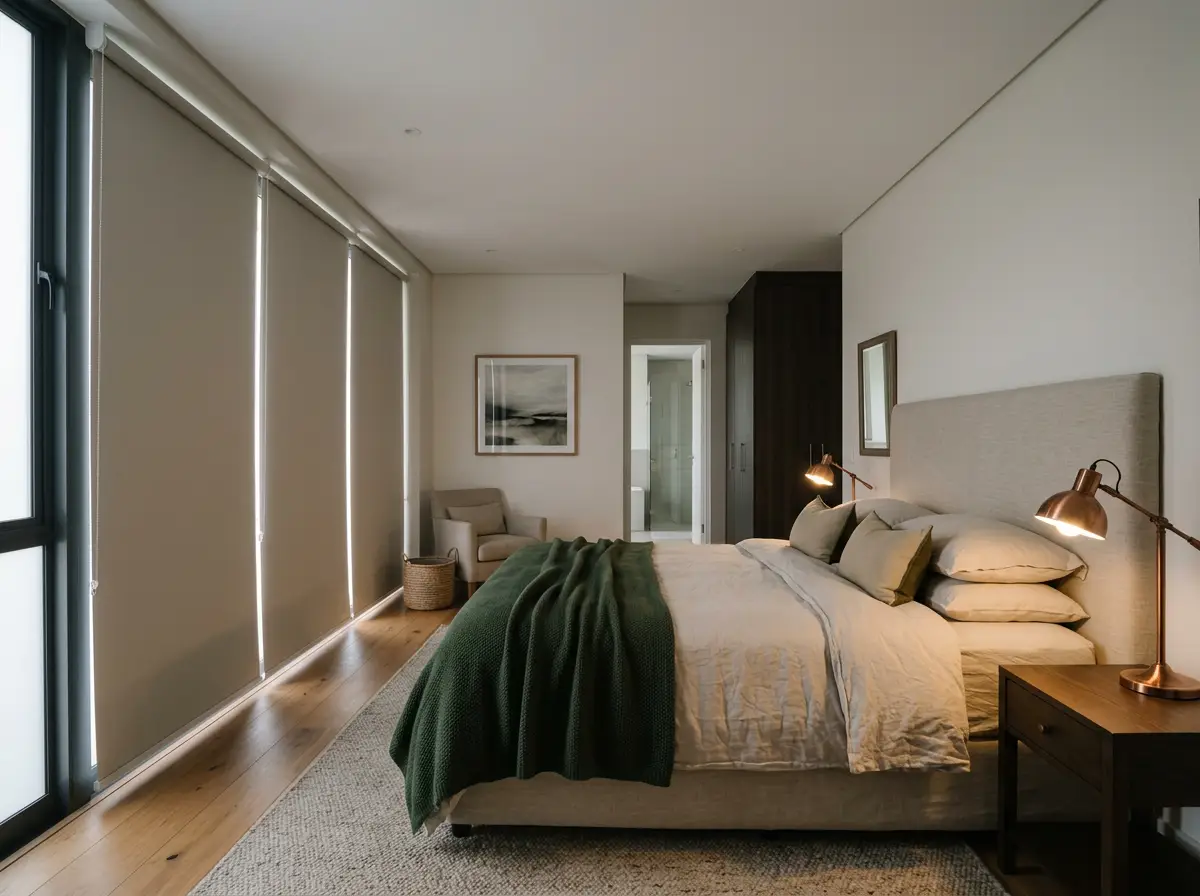
Almost nobody shades a whole house at once, and almost nobody should. An Erinvale home usually has four or five openings doing real damage to how the place is lived in, and a dozen more that are perfectly fine as they are. This guide sets out the order we would work in on this estate, and says honestly what each step buys you.
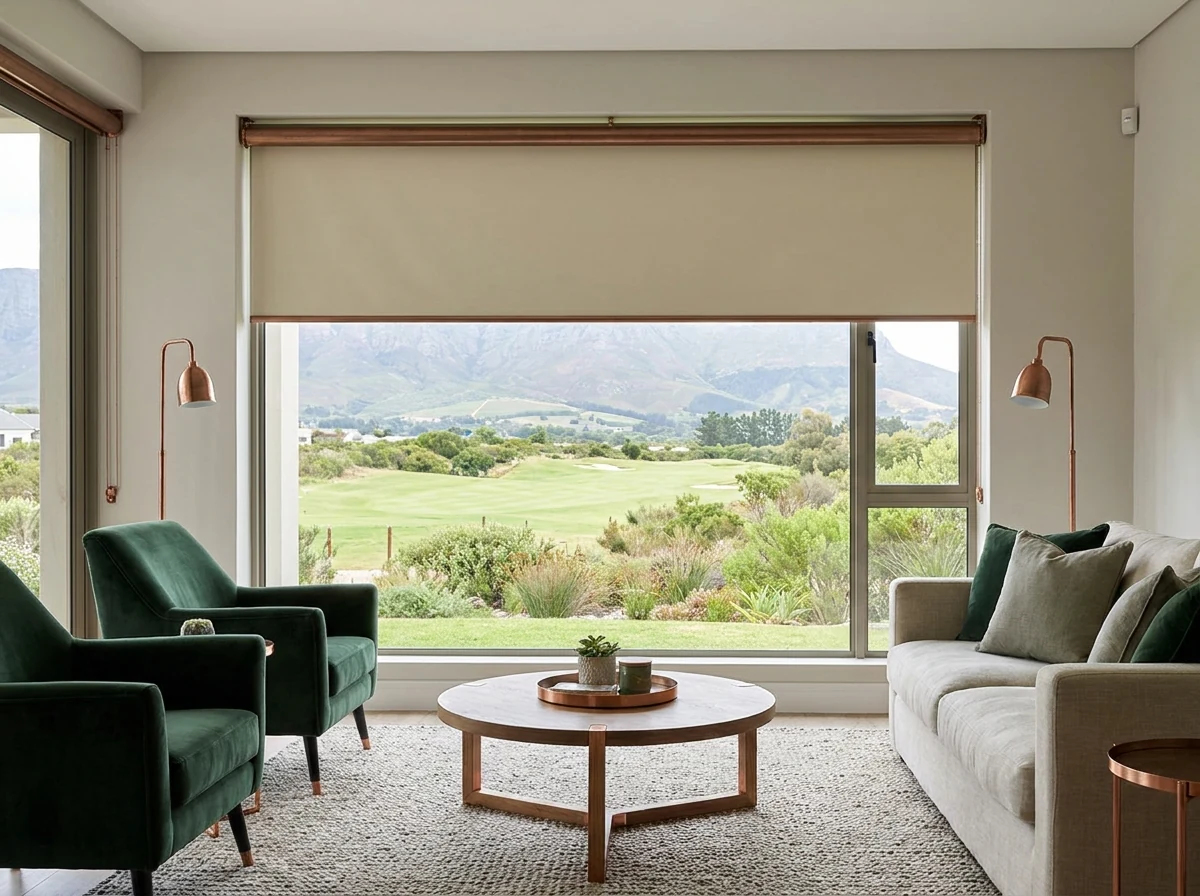
The opening that usually comes first: a wide fairway-facing window, and a mesh open enough to keep what is behind it.
Why an Erinvale house rarely needs everything at once
Somerset West sits at the foot of the Helderberg on the eastern shore of False Bay, and the mountain behind it rises to roughly 1,137 metres.12 Erinvale is laid out on those lower slopes around its golf course, which produces a very particular kind of house: one designed outward. The architecture points its biggest glass at the course, the fynbos and the ridge line, because that is what the address is for.
The consequence is that the shading problem here is concentrated rather than spread. A handful of openings carry nearly all the discomfort — the big view glass, the double-volume stair, the veranda — while bedrooms on the sheltered side and windows shaded by a neighbouring roof are entirely comfortable and need very little. Treating the house as one blanket order wastes money on the second group to fund the first badly.
Do four openings properly this year and the house changes. Do sixteen cheaply and it mostly just looks furnished.
So this is a ranked list, not a catalogue. Work down it as far as your budget goes, and stop without guilt.
First
First: the room that empties at four o'clock
Every house on this estate has one. It is the room with the best glass and the best view, and in summer nobody is in it between about three and six because it has become uninhabitable. That room is where the first rand should go, and it is also the one place where the cheap answer genuinely does not work.
The reason is physical rather than commercial. Once sunlight has crossed the pane, its energy is in the room. A blind on the inside can intercept the light beautifully, but the fabric then warms and radiates that heat back into the space. It fixes glare and only partly fixes heat. Intercept the same energy on the outside of the glass and the pane never warms in the first place. That is why our exterior range is the premium tier, and why we lead with it on a hot elevation.
What we would put there
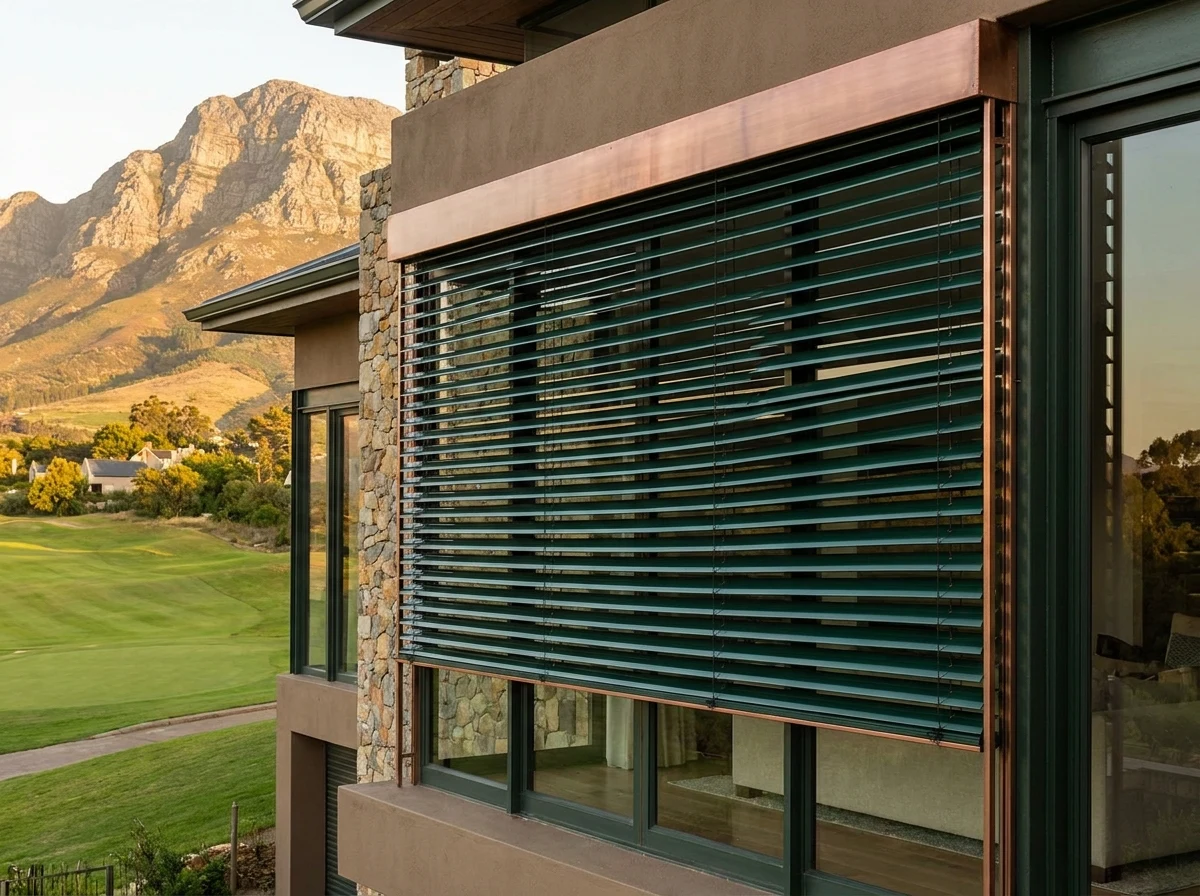
External venetian blinds — aluminium slats carried outside the glass in guided rails, tilting as well as raising. Tilt is what makes them worth the money on this estate: you cut the beam and keep the fairway. Motorised, they raise clear away in winter, when the low sun coming into that room is a benefit rather than a problem.
Roller shutters where a room wants more than shade — rigid slats rolling down outside the pane for darkness and quiet as well as heat. Plainly stated: these are shading shutters, for heat, glare and blackout. A security-rated product is a different item, available on request.
A sunscreen roller inside the glass where an exterior fixing is genuinely not possible. It is the honest second best — much cheaper, clearly weaker on heat, and still excellent on glare and UV. On a fairway-facing window a light-coloured mesh at roughly 3–5% openness keeps the view legible while taking the sting out of the light.
One honest caution before you get attached to the idea: anything fixed to the outside of your house is visible from the estate, and on a golf estate that generally means it needs approval before it is ordered. More on that below — it is a step, not an obstacle, and it is easier when the drawing exists first.
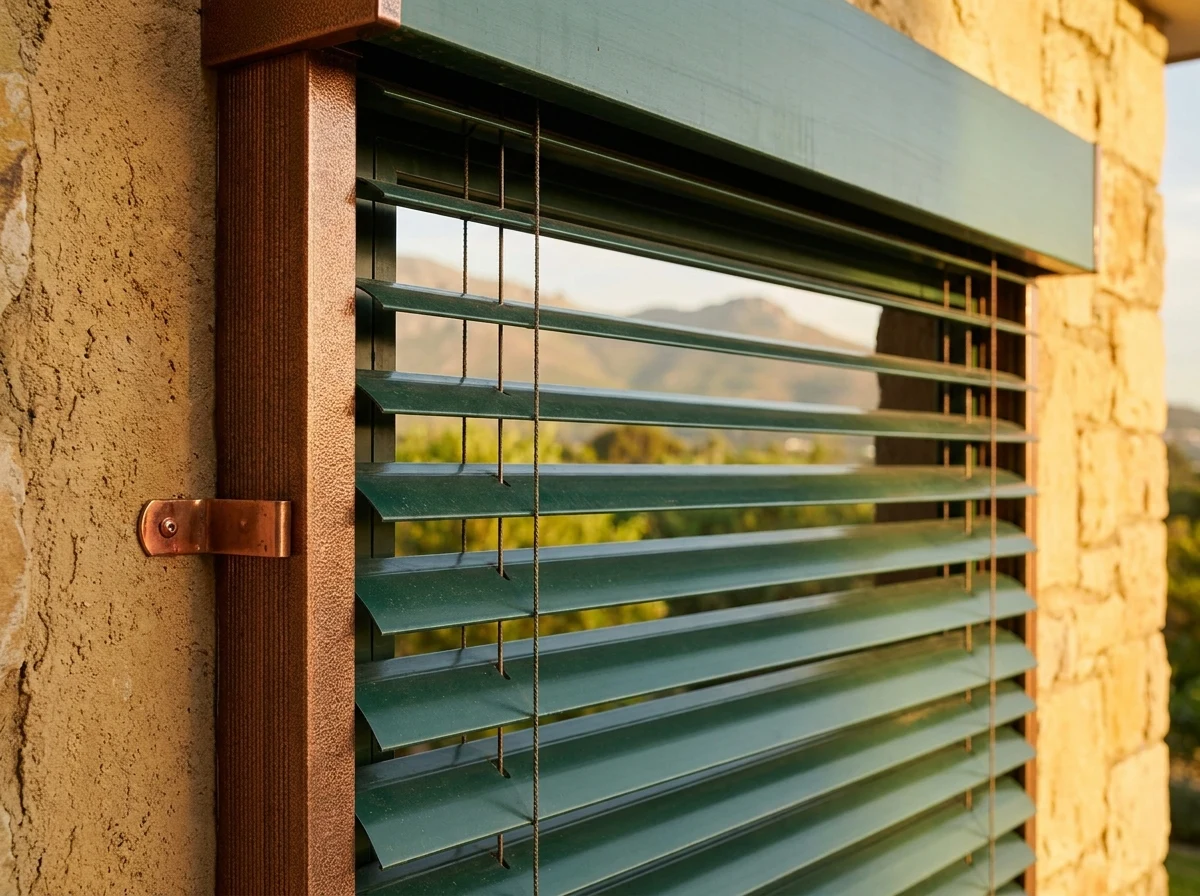
Slats working outside the glass, in a colour chosen to sit with the stone and render rather than argue with it. The performance and the approval are the same decision.Second
Second: the glass nobody can reach
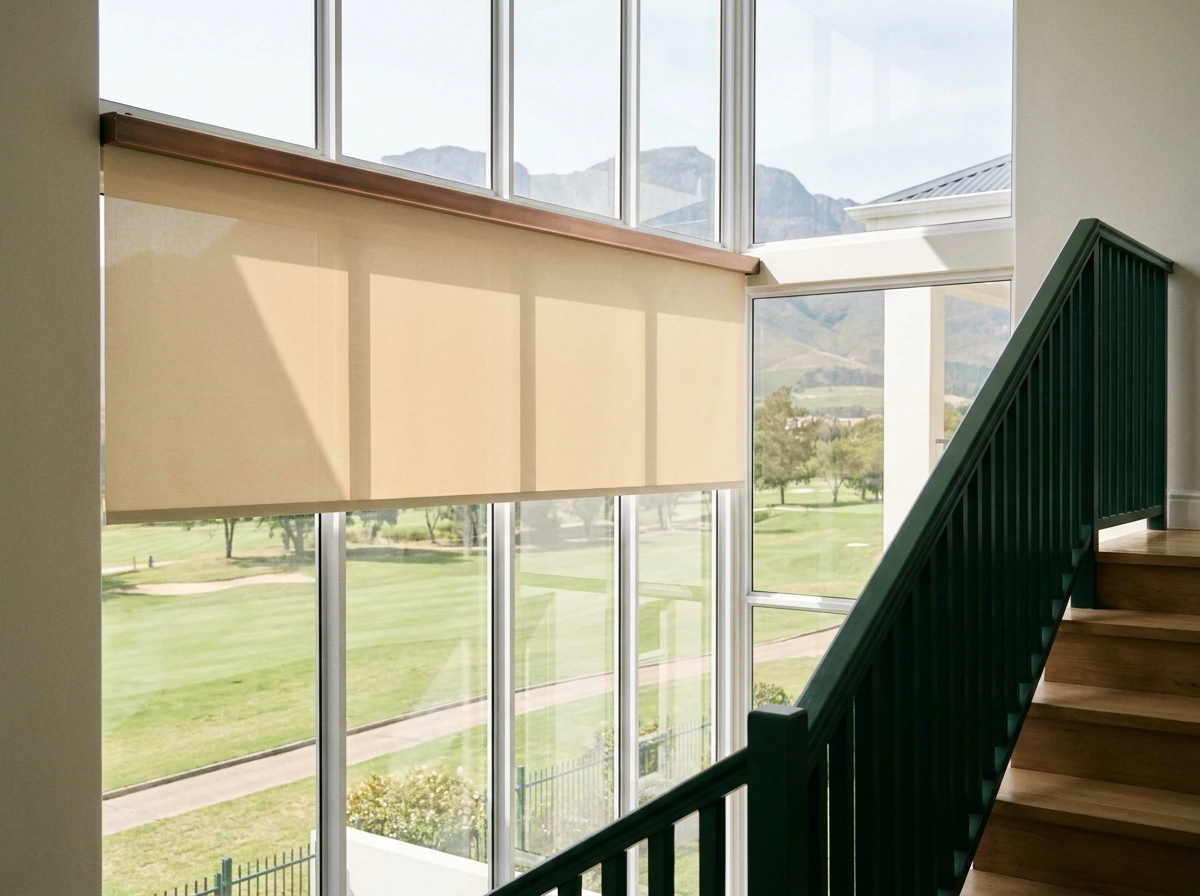
Second on the list because it is the one people postpone for years and then wish they hadn't. Estate homes of this generation are full of tall glazing that no ladder in the garage will service: the double-volume stairwell, the gable window over a landing, the clerestory band above a lounge.
Two things make it urgent. It is usually the single largest area of unshaded glass in the house, so it does a lot of the heating. And it is high, which means it takes sun for far more of the day than anything at ground level, including the hours when the low beam is under an eave downstairs.
The answers are specific:
Motorisation is not a luxury here, it is the mechanism. A blind you cannot physically reach must be operated by a motor, on a remote, a wall switch or a timer. Cabled where power is available; rechargeable battery tube where running a cable would mean opening a ceiling.
Shaped and raked glass needs a tensioned system. A gable or triangular pane cannot carry an ordinary hanging blind — the fabric has to be held in side tracks so it follows the rake and stays flat instead of sagging away from the slope.
Choose the fabric for a surface you will rarely touch. High glass gets cleaned once a year if it is lucky. A smooth, dust-shedding fabric in a mid tone is a far better long-term choice up there than a textured one.
Full-height stair glazing, operated by motor because there is no honest alternative. Solve this one while the rest of the house is being measured, not five years later.Third
Third: the veranda you paid for and don't sit on
Third, because it converts unused square metres into used ones faster than anything else on this list. Most homes here have a covered veranda or patio facing the course that is lovely at eleven in the morning and abandoned by mid-afternoon — too bright on one side, too windy on the other.
Wind is the deciding factor and it deserves respect. The south-easterly that dominates the Cape summer blows most persistently through the warm months and is at its strongest in the afternoon,3 and on a slope below the Helderberg you also get gusts coming off the mountain itself. That combination is what destroys outdoor shading fitted without thought.
Zip screens where it is exposed
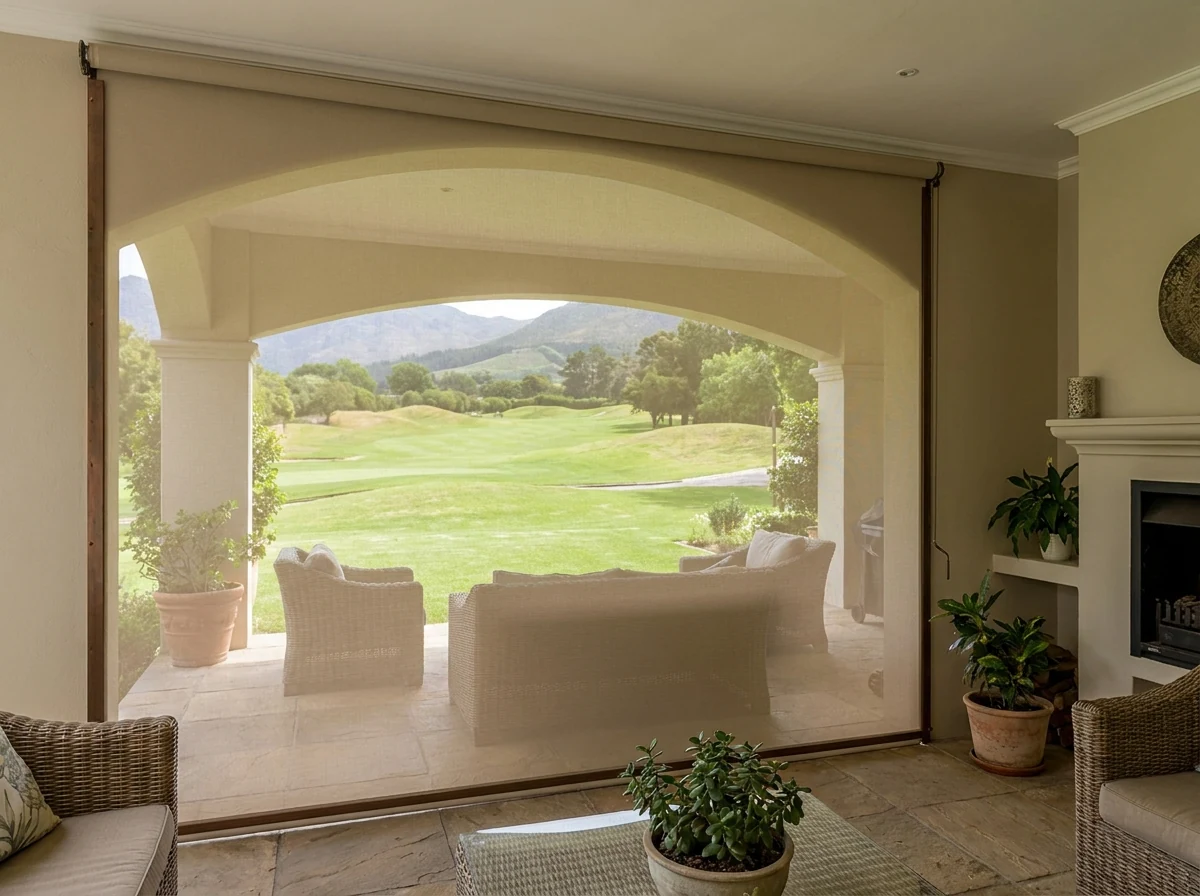
A zip screen runs its mesh under tension inside side channels, held on both edges. It therefore stays flat in a gust that would lift and fold an arm-supported awning, and it can be dropped down the open side of a veranda to turn it into a genuinely usable room — still see-through, still with the course in front of you, but out of the wind and out of the glare.
A folding-arm awning where it is sheltered
Where a patio sits in the lee of the house, a retractable folding-arm awning gives more open shade and a better feeling of the sky. The non-negotiable is that it retracts into a closed cassette and carries a wind sensor, so it takes itself in before the front arrives rather than after. An awning left permanently extended through an Erinvale summer is an awning you will be replacing.
Down over an arched veranda opening: the wind is out, the course is still there through the weave. This is the step that most changes how much of the house gets used.Fourth
Fourth: the bedrooms, where fitting beats fabric
Bedrooms come fourth because they are usually a comfort improvement rather than a rescue — but there is one piece of knowledge here that saves people a great deal of disappointment.
Darkness is decided by the fitting, not by the fabric. Every blockout fabric is opaque; that is what the word means. What wakes you at first light is the line of light coming in around the edges of the blind. Fitted neatly inside the reveal it looks tidy and leaks a hairline down each side. Fitted over the opening, wider and lower than the reveal, it is dramatically darker and covers the joinery. If you want a genuinely dark bedroom, that is the conversation to have — not a conversation about a darker fabric.
Two more bedroom notes specific to this estate:
Keep colours light on the room side. A pale blockout is just as opaque as a charcoal one and leaves the room far less oppressive on a grey winter morning.
Where a room needs both view and privacy — a guest room facing a neighbouring stand, or a study off a bedroom — a banded day-and-night blind lets you line the sheer bands up for view or offset them for privacy without lowering anything.
Stone-coloured rather than charcoal, and taken down the full height of the opening. Both of those are fitting decisions, and both matter more than the fabric name.Fifth
Fifth: the wet rooms and the small hot windows
Last, and cheapest, and genuinely worth doing once the rest is settled. Bathrooms, sculleries, a laundry, the small high window over a kitchen sink.
The rule here is about material, not product. Cape winters on this side of False Bay bring sustained rain rather than short storms, and a room that runs steamy in winter is unkind to timber. Real timber slats bow and mark once moisture gets into them, and no amount of care undoes it. Aluminium venetians in every wet room — they wipe down, they tilt for privacy without losing all the light, and they do not care about humidity. Save the timber for a study or a bedroom where it will look magnificent for twenty years.
Small west-facing windows belong in this tier too. They can be genuinely uncomfortable for an hour a day, and a modest sunscreen roller or a tilting venetian solves them for very little.
Quality
Where money should buy quality instead of quantity
There is one place on this estate where we would rather you did fewer openings than accept a cheaper specification: anything mounted outdoors.
Erinvale is close enough to False Bay to sit in genuinely marine air, and chloride-bearing coastal air accelerates the corrosion of metals — it is one of the most aggressive ordinary atmospheres a fitting can live in.4 Cheap exterior hardware does not fail gracefully here. It pits, it stains the wall below it, the fixings seize and the mechanism stops running long before the fabric wears out.
So on anything outside we specify powder-coated aluminium, sealed cassettes and corrosion-resistant fixings as standard, and we will tell you plainly that even good hardware on this coast appreciates an occasional rinse with fresh water. That is not a disclaimer to protect us; it is the maintenance that makes the difference between eight years and fifteen.
The same logic applies to motors and sensors. A wind sensor is the cheapest insurance on the property, because the thing it prevents is not wear — it is a single gust removing an awning from a wall.
The tilt mechanism is the part that decides how long an exterior product lasts on this coast — not the slat, and not the colour.Approval
The estate's look, and staying inside it
Estates of this kind hold their character through rules, and in South African law a residential estate is generally administered as a community scheme, with a governing body whose rules bind owners.5 In practice that means a set of published guidelines about what may appear on an elevation, and a review step for anything visible from outside your own boundary.
We want to be careful here: we do not hold Erinvale's guideline document and we do not quote from it. The estate issues it to its own owners, and the only reliable version is the one you obtain from the estate itself. What we can tell you is the pattern, and how we prepare for it.
Inside the window opening is a furnishing. Rollers, venetians, cellular blinds and day-and-night blinds fitted within the reveal show nothing new outside and are almost never a review matter.
Anything bolted to the outside is an alteration. An external venetian headbox, a roller shutter box, a screen channel or an awning cassette changes the elevation. Assume it needs sign-off.
Neutral, estate-friendly colourways as standard. We work in muted powder-coat and fabric tones by default rather than proposing something that has to be argued for, and we will colour-match to the render, stone or joinery already on your house.
A drawing before an order. For anything exterior we prepare the elevation photograph, the dimensions, the colour reference and the fixing detail so you have something complete to submit — and we hold manufacture until you have an answer, because a made-to-measure product in the wrong colour is a remake, not an adjustment.
We will not describe an approval as a formality, and we do not lodge anything in your name.
On site
What a walk round the house reorders
This ranking is a good default. It is not your house. Five things routinely move an opening up or down the list, and all five need somebody standing in the room:
Which way your best glass actually faces. Stands here point in every direction around the course, and a north-facing lounge and a west-facing one are completely different briefs even on the same street.
What is already shading you. A deep overhang, a mature tree, a neighbouring roof or the mountain shoulder itself may mean an opening you assumed was the worst in the house is already handled.
Where the neighbours' windows are. On an estate, privacy is often the real brief and heat is the stated one. That flips the product choice from a mesh to something you can tilt.
What the wall is made of, and where the power is. Stone cladding, render over block, or a timber soffit each want a different fixing — and one of them may rule an exterior product out on that elevation entirely.
How the household actually lives. A room used at breakfast and a room used at sundown need opposite things. A floor plan cannot tell us which is which.
That is why the measure is free and unhurried, and why we do not quote from photographs. Every one of these is cheaper to discover before a quote than after a fitting.
Start with the one room that beats you in summer.
A free in-home measure at Erinvale or anywhere on the Helderberg belt, then a written quote per window — in whatever order suits your year.
Say which room stops being usable, and a consultant will phone you back to arrange the free measure at a time that suits your week.
→
Ranked, not bundled
We are happy to quote a first phase and leave the rest for later. Nothing on this site requires you to do the whole house at once.
→
Exterior work comes with paperwork
If your first phase includes anything fixed outside, the elevation drawing and colour reference for your estate submission come with the quote.
Sources
Where the facts above come from
Every geographic, climatic and legal statement on this page traces to one of the references below. The ranking itself, the product choices and the durability advice are our professional opinion, not a finding — and we hold no estate's guideline document.
Wikipedia — Somerset West (the town's position at the foot of the Helderberg on the eastern side of False Bay, and its Mediterranean-type winter-rainfall climate).
Wikipedia — Helderberg (the mountain immediately behind Somerset West and the height of its summit, about 1,137 m).
Wikipedia — Cape Doctor (the persistent south-easterly wind of the Cape summer months, its seasonality and its afternoon strength).
Wikipedia — Corrosion (chloride-bearing marine air as an aggressive atmospheric environment for metals, and the mechanisms by which coastal exposure accelerates corrosion).
SAFLII — Community Schemes Ombud Service Act 9 of 2011 (the definition of a “community scheme”, which covers homeowners' associations and sectional title schemes, and the framework within which scheme rules bind owners).
South African Weather Service — weathersa.co.za (official South African climate and forecast data — the place to check the Helderberg belt's own monthly figures rather than take ours on trust).
Nothing on this page is legal advice, a statement of any estate's rules, or a building assessment. Those belong to your estate's managing agent and architectural review process, to your local authority, and to a suitably qualified professional. Treat this page as free general guidance and nothing more — there is no obligation attached to reading it.
Download a copy to share with whoever else has a say in the windows.
Erinvale BlindsUsually replies in a few minutes
Details shared here are only used to arrange your call-back. (POPIA)