Folding-Arm Awnings
Shade on demand over the entertainment patio — no posts, no permanent roof, gone again the moment you want the winter sun back.
Shade with a season switch
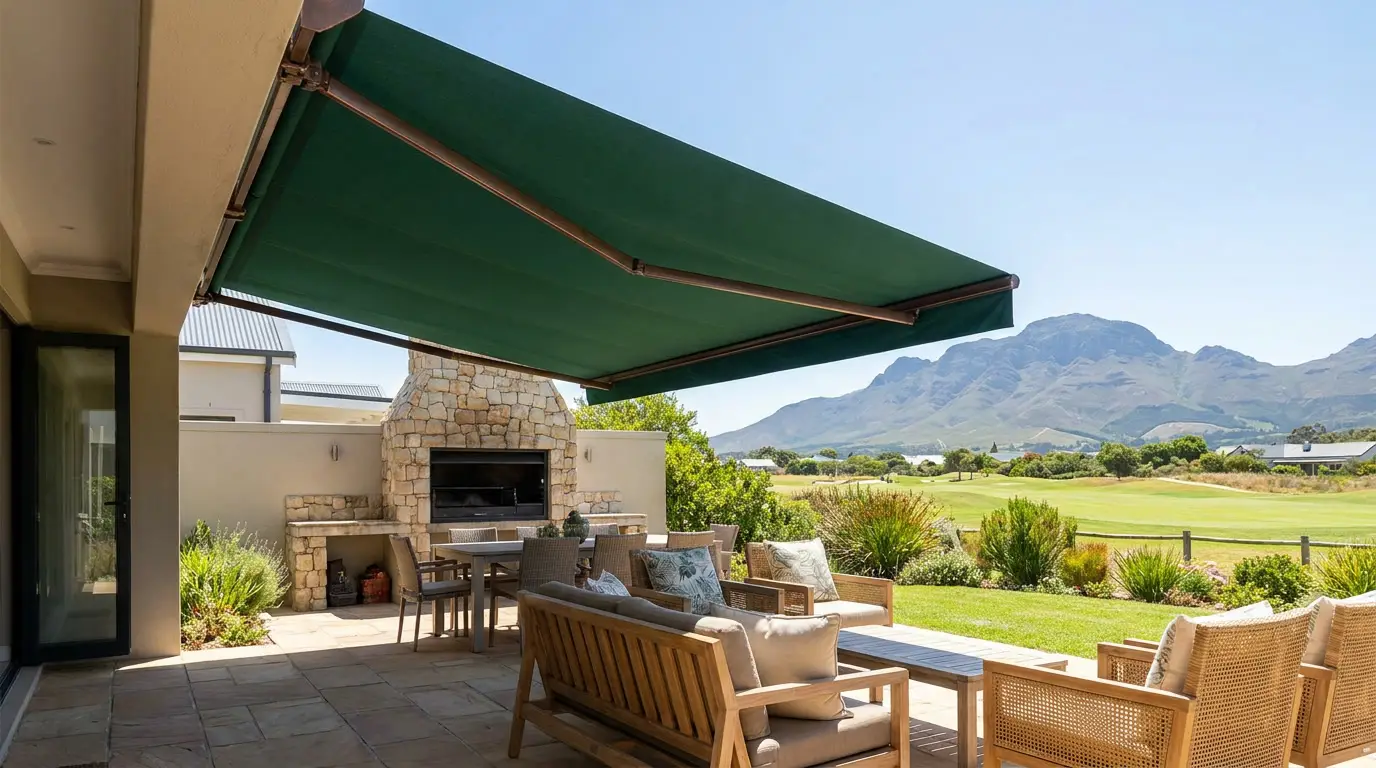
A folding-arm awning runs on spring-tensioned arms out of a headbox cassette — extend it over a braai or entertainment patio in summer, retract it in winter and let the low Cape sun back in. No posts means no interrupted view down the fairway and no clutter around the braai itself.
Projection runs to roughly 3–4m over wide spans, and solution-dyed acrylic fabrics hold their colour under direct Cape UV far longer than an untreated fabric would.
02Why the motor and sensor matter here
An awning caught open when the south-easter picks up, or when a mountain gust comes down off the Helderberg, doesn't survive it — the arms bend, the fabric tears. Every awning we fit on this side of the mountain carries a motor and a wind sensor as the responsible spec, not an optional extra: it retracts itself before the gust arrives, whether or not anyone's home.
03Cassette options
A full cassette seals the fabric and arms away completely when retracted — the right call for an exposed, weather-facing patio near this coastline. Semi-cassette and open-mount versions suit more sheltered positions and cost less. Crank handle operation exists, but on anything wide or exposed we'd steer you toward motorised.
- Motorised with wind-sensor auto-retract, standard on exposed patios
- Solution-dyed acrylic fabric holds colour under Cape UV
- LED lighting and drop-valance add-ons available on premium lines
Shade, not rain protection
An awning handles light drizzle at a pitch, never standing water or a proper Cape downpour — and the fixing substrate (brick, timber or steel) needs a site assessment before we quote, not a guess.
What it costs
The guide runs by the square metre of projection, installed — the shade thrown over the patio, not the wall behind it. Crank-operated: R3,500 to R5,500, cheapest with an open or semi-cassette mounting and dearest with a full cassette shutting fabric and arms away from salt and rain. Add a motor and a wind sensor and it runs R5,500 to R7,500.
On a Helderberg patio the sensor is a specification decision, not a sales one: a south-easter finds an awning that was left out. Compact awnings attract a minimum, since brackets, arms and crew do not halve when the projection does. Substrate can move the figure, because a timber fascia or a rendered parapet sometimes needs what solid brick does not. Measured at no cost, then priced in writing.
Entertainment patios facing the fairway or the mountain, across the Helderberg belt, are where awnings work hardest.
Get your Erinvale patio measured
Free in-home measure, a full written quote, no obligation.
Book your free measure